What Soft Skills Should You Put on a Resume?

Most resumes list soft skills.
Very few show them in a way that actually helps.
Job seekers are often told to “highlight soft skills” without much guidance on what employers are really looking for. The result is a resume filled with familiar phrases like hard-working, team player, or strong communicator—words that sound positive but don’t give a hiring manager much to work with.
The issue usually isn’t a lack of soft skills. It’s that resumes describe traits instead of showing behavior.
Why Listing Soft Skills Doesn’t Work
When employers review a resume, they typically first confirm that a candidate meets the basic technical requirements of the role. Once that box is checked, attention shifts to something less obvious: how this person is likely to function on the job.
Employers are asking practical questions. How does this person communicate? How do they handle changes in priorities? What happens when timelines shift or something doesn’t go as planned?
At the resume stage, employers don’t yet have performance data. All they have is what the resume shows. A list of adjectives doesn’t provide evidence—it presents claims that are difficult to evaluate.
Which Soft Skills Actually Belong on a Resume
You don’t need to list a long set of soft skills. In practice, a small group tends to matter across many roles, particularly in team-based environments.
Skills related to communication, dependability, teamwork, adaptability, and problem-solving come up repeatedly in hiring conversations. What matters isn’t naming these skills, but demonstrating how they’ve shown up in your work.
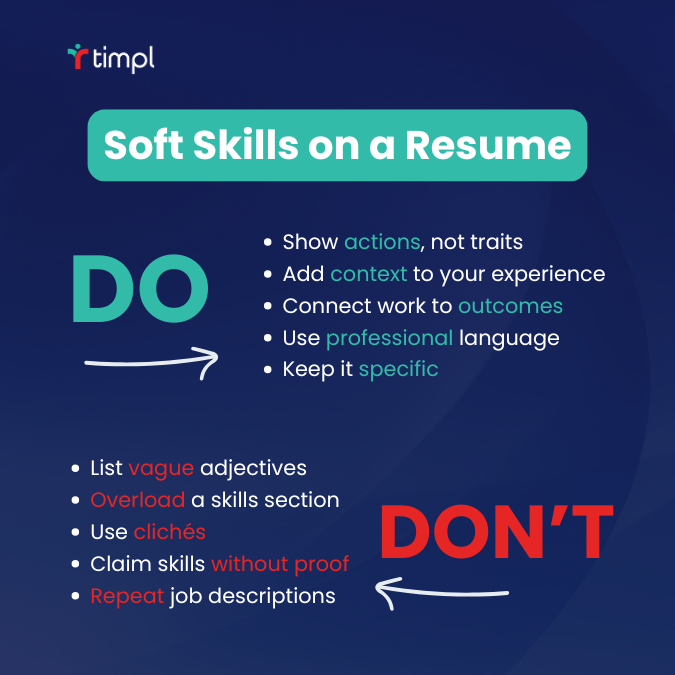
Instead of stating that you’re reliable, show consistency through your work history. Rather than claiming strong communication skills, describe how you shared information, coordinated with others, or handled feedback in real situations.
Check out Do you still need an objective on your resume?
How to Show Soft Skills Through Experience
The strongest resumes embed soft skills directly into work history.
Compare these two lines: “Collaborated with a team to complete projects.” versus: “Worked with design and engineering teams to launch a product two weeks ahead of schedule.”
The second example provides context, shows collaboration, and connects behavior to an outcome. It gives the reader something concrete to evaluate.
Often, one well-written line can communicate multiple soft skills at once without naming them.
A Practical Note on Resume Keywords
While soft skills are most effective when shown through experience, it’s still reasonable to include a small Core Competencies or Skills section for keyword visibility—especially for applicant tracking systems (ATS).
If you do, keep the language professional and specific. Terms like stakeholder management, cross-functional collaboration, or process coordination are more effective than vague phrases such as good with people or team player.
Keywords can help with visibility, but they should be used sparingly and always supported by experience elsewhere on the resume.
Check out How to build a resume reference list that wins jobs
Soft Skills That Usually Don’t Add Value on Their Own
Some words are so common that they rarely help unless they’re backed by a clear example.
Terms like hard-working, motivated, or positive attitude aren’t incorrect, but many employers treat them as baseline expectations. Without context, they don’t help distinguish one candidate from another.
If a soft skill can’t be supported by a specific situation or outcome, it’s usually better left off the resume.
Clear, specific examples give employers something they can picture—and make it easier to decide who moves forward to the interview stage.
Ready for your next thriving job? Explore your opportunities with TIMPL.
Related articles
What Is a Good Weakness to Say in a Job Interview?
Exit Interview Checklist with Examples
How to follow up after a job interview
Best interview questions to leave a lasting impression
"Tell Me About Yourself." - Expert answer.
How To Negotiate Salary (using power dynamics)