How to Get Hired, Get Promoted, and Get Paid More in Industrial Maintenance
Industrial maintenance is one of the most stable, in-demand, and genuinely rewarding trades you can enter right now. Facilities need skilled technicians more than ever — and they're struggling to find them. That means real leverage for people who are serious about building their skills and showing up consistently.
But "just get your foot in the door" advice only goes so far. If you're 0–2 years in — or looking to break in — what you actually need is a concrete roadmap: what skills to build first, which certifications to prioritize, how to move up faster than your peers, and what pay looks like at each stage.
That's exactly what this guide is.
What you’ll take away:
The core technical skills that matter most in your first two years
Which certifications get noticed at every career stage
Verified salary benchmarks from entry level to supervisor
The mindset shift that separates good techs from great ones
Specific actions to take at year one that set you up for leadership
What you can realistically earn
The BLS puts the median annual wage for industrial machinery mechanics at $63,510 as of May 2024 — with entry-level workers typically starting below $44,430 and the top 10 percent earning more than $91,620. Step into a supervisory role and the median sits around $79,830, though pay varies widely depending on your industry, region, and facility size. Pharmaceutical, aerospace, and energy plants consistently pay above these figures.
Why this field is wide open right now
The skilled trades gap is real. The Bureau of Labor Statistics projects demand for maintenance professionals to grow significantly — largely because experienced workers are retiring faster than new ones are being trained. At the same time, factories, distribution centers, and food processing plants are adding more automated equipment — which actually increases the need for qualified maintenance staff, not the opposite.
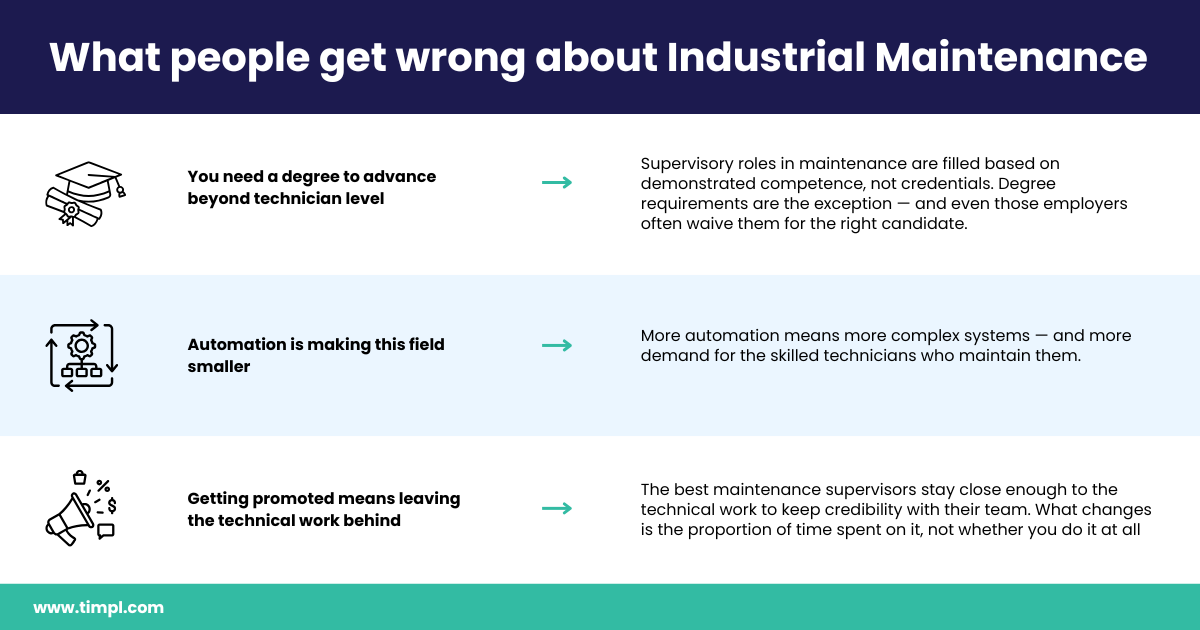
You don't need a four-year degree. You can start earning a livable wage while building skills. And within five to eight years, you can be managing a team or running a shift. The runway is there — it just requires intention.
How to Move Up, and Earn More in Industrial Maintenance
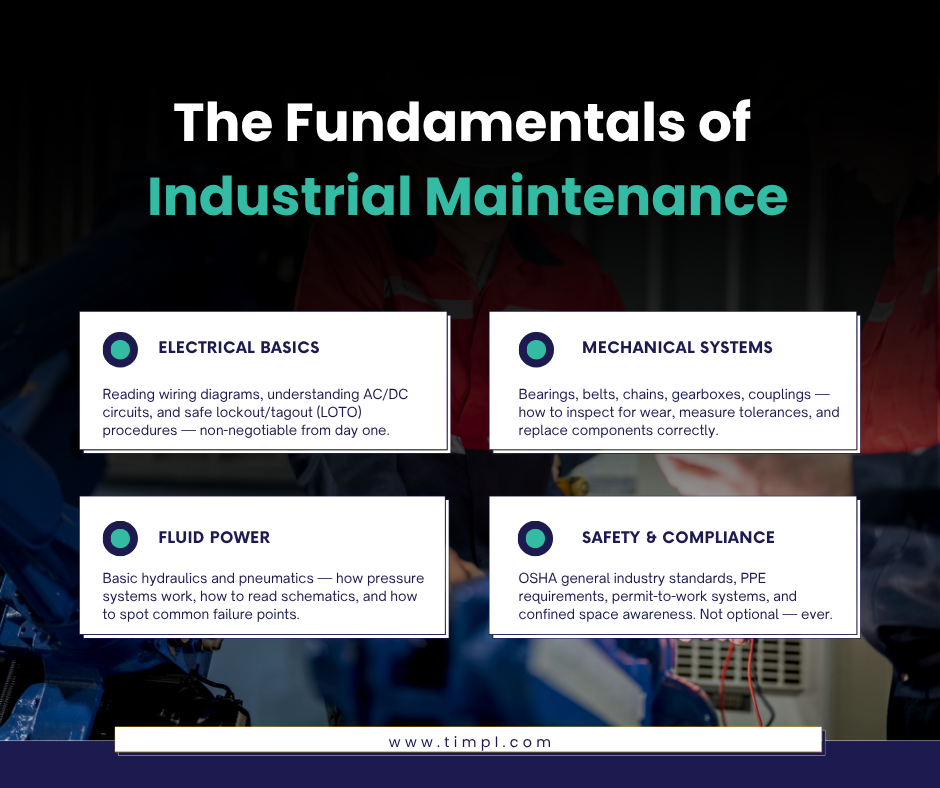
1. Learn the fundamentals before you specialize
In your first year, your job is to become reliable and absorb everything. You will not know everything — and no one expects you to. What experienced techs and supervisors are watching for is whether you pay attention, ask smart questions, and take safety seriously without being told twice.
The technicians who advance fastest are not always the most naturally talented. They are the ones who show up every day, write things down, and ask "why does this fail this way?" instead of just completing the repair and moving on.
2. Get comfortable with the tools of the modern shop floor
Modern facilities do not just use wrenches. As you move past your first year, you will encounter technologies that were not common in maintenance shops a decade ago. Getting familiar with them — even at a surface level — puts you ahead of techs who have not made the effort.
CMMS software
Platforms like Fiix, eMaint, or MP2 track work orders, PMs, and asset history. Most facilities use one. Learn yours thoroughly — techs who document well stand out immediately.
PLCs (basic literacy)
Programmable Logic Controllers run automated equipment. You do not need to write programs — but reading ladder logic and interpreting fault codes is increasingly expected.
VFDs & motor controls
Variable Frequency Drives control motor speed in conveyors, pumps, and fans. Knowing how to read VFD parameters and fault messages can save hours of downtime per shift.
Predictive tools
Vibration analysis, thermal imaging, and ultrasound equipment are common in mid-to-large facilities. Familiarity signals you are thinking beyond reactive repairs.
You will not master all of these quickly — and you do not need to. What matters is that you are not intimidated by them. Ask to shadow the tech who handles VFD faults. Sit in when someone pulls fault logs off a PLC. These moments are available to anyone who asks, and they compound fast.
3. Get certified —strategically
Certifications will not replace experience, but the right ones signal commitment to employers and open doors to better pay. Here is what is worth your time early on:
OSHA 10 or 30 — General Industry
Table stakes. Most employers expect it. OSHA 30 shows you are serious about safety leadership.
CMRT — Certified Maintenance & Reliability Technician
Offered by SMRP. Widely respected in manufacturing. Tests mechanical, electrical, and PM fundamentals.
NIMS credentials
Strong for early-career techs. Demonstrates verified competency beyond on-the-job basics.
State journeyman electrician license
If you are leaning electrical, this is the gold standard and significantly increases earning potential.
EPA 608 certification
Required by federal law if you handle refrigerants. Opens doors in facilities with large HVAC systems.
CMRP — Certified Maintenance & Reliability Professional
Offered by SMRP. The step up from CMRT — for senior techs and those moving toward leadership.
MLT — Machinery Lubrication Technician
Offered by ICML. Requires 2+ years experience. Highly valued in manufacturing facilities with heavy rotating equipment.
CPMM — Certified Plant Maintenance Manager
Offered by AFE. Requires 2+ years in maintenance management. The credential for supervisor and manager level roles.
4. Start thinking in root causes.
This is the mindset shift that separates technicians who stay at entry level from those who move up quickly. Most maintenance teams spend too much time fighting fires — equipment breaks, they fix it, it breaks again next month. The facilities that run best have technicians who ask a different question: why did this break?
When you fix a conveyor belt that jumped its track, do not just re-tension it and move on. Ask: was the idler worn? Was the loading uneven? Was there a structural misalignment no one had caught? Document what you found. Tell your supervisor. Log it in the CMMS. That habit gets noticed quickly — and it is exactly how preventive maintenance programs improve.
“A 2023 ABB survey of 3,215 plant maintenance leaders found the median cost of unplanned downtime across industries is $125,000 per hour — and that figure has only climbed since.”
Here are three habits that set you apart:
Ask “Why” five times
A simple root cause analysis habit. Each answer points to a deeper cause. Get to the source, not just the symptom.
Document everything
Log repairs in the CMMS even when it feels like extra work. Patterns show up over weeks and months, not hours.
Take PM seriously
Preventive maintenance feels routine until it stops a costly unplanned shutdown. Be the tech who treats it as seriously as emergency repairs.
5. Start acting like a leader from year one
Maintenance supervisor roles do not go to the most technically skilled person in the shop. They go to the person management trusts to keep the team running calmly and effectively when multiple things go wrong at once. That trust is built long before any promotion conversation happens.
The supervisor role is people-focused as much as it is technical.
Here is what it actually involves day to day:
Managing work orders, PM schedules, and emergency priorities across a team
Communicating clearly with production, operations, and plant leadership in real time
Owning downtime metrics and explaining performance to management
Mentoring junior techs and building the team's overall skill level over time
Making fast decisions under pressure when failures, staffing gaps, and production demands arrive at the same time
Ensuring all work meets safety, compliance, and quality standards across every shift
The best way to prepare is to start acting like a lead now, before you have the title. When a junior tech is stuck, walk them through the diagnosis instead of just doing it for them. When you spot a recurring equipment problem, put it in writing and bring a solution — not just the complaint. When there is a gap in coverage, step up without being asked. These are the behaviors that supervisors notice and remember when a role opens up.
Also, start learning to communicate in business terms. "The conveyor went down for 45 minutes" is a repair note. Knowing what that stoppage actually costs the facility — and being able to explain it — is how you start sounding like someone ready for more responsibility.
A note on what "success" looks like here
It's worth saying plainly: not everyone who excels in industrial maintenance wants to move into management, and that's not a failure of ambition. Some of the most valuable people in any facility are highly skilled technicians who've chosen depth over breadth — specialists who've become irreplaceable in their domain.
If that's the path you want, own it. Senior specialist roles in this field are well-compensated, widely respected, and increasingly hard to fill. The market for someone who truly understands industrial automation, or who can diagnose electrical faults that others can't, is strong and getting stronger.
The point is to be deliberate about where you're going — whatever that looks like for you.
Related Resources
Interview Tips
10 Tough Interview Questions Recruiters Love to Ask
How to Decline a Job Offer the Right Way
How to Accept a Job Offer (Without Second-Guessing Yourself Later)
How to Ask Your Boss for a Raise
Exit Interview Checklist with Examples
How to follow up after a job interview
How To Negotiate Salary (using power dynamics)
Do You Still Need an Objective on Your Resume?
Career guide
Is Power Plant Operator Still a Good Career?
Top 5 Skilled Trade Jobs That Pay Big Without a Degree
What Does a Millwright Do? A comprehensive guide
What Is a Machinist and What’s the Future of This Career?
What It’s Really Like to Be a QC Inspector in Manufacturing
What Is a Pipefitter and Is It a Good Career?
The Wind Turbine Technician Career: Everything You Need to Know